







Expired medications introduce avoidable compliance risk, financial waste, and operational exposure when detection depends on manual checks and fragmented workflows. RFID-enabled inventory management, paired with disciplined routines, gives pharmacy leaders earlier visibility into expiration risk and tighter control across kits, trays, and disparate inventory. Health systems adopting RFID are shifting expiration management from reactive discovery to proactive prevention.
Expiring Medications Remain a Persistent Risk at Scale
Manual inspection schedules leave long gaps between checks, allowing medications to move closer to expiration without visibility. In large hospital environments, these gaps are amplified by distributed inventory that spans pharmacies, procedure areas, crash carts, and mobile kits, where no single view reliably reflects true expiration exposure.
Several factors compound this risk:
- Inventory distributed across many locations, limiting centralized oversight
- Diffused accountability as medications move between teams and care settings
- Fragmented processes that prevent no single view of enterprise-wide expiration risk
Barcode-based solutions improve documentation but are limited in their application and still rely on line-of-sight scanning and consistent staff execution. Items must often be handled individually, scanned intentionally, and recorded accurately, which creates friction at scale. Common challenges include:
- Missed or delayed scans during periods of high workload
- Inconsistent execution as staffing levels fluctuate
- Expiration checks that are deferred or sampled rather than comprehensive
- Usage limited to inventory stored in trays
As a result, expiration issues tend to surface late. Audits, recalls, and near-miss events often become the point of discovery, when remediation is more disruptive, waste is unavoidable, and compliance risk has already been realized.
How RFID Transforms Expiration Management
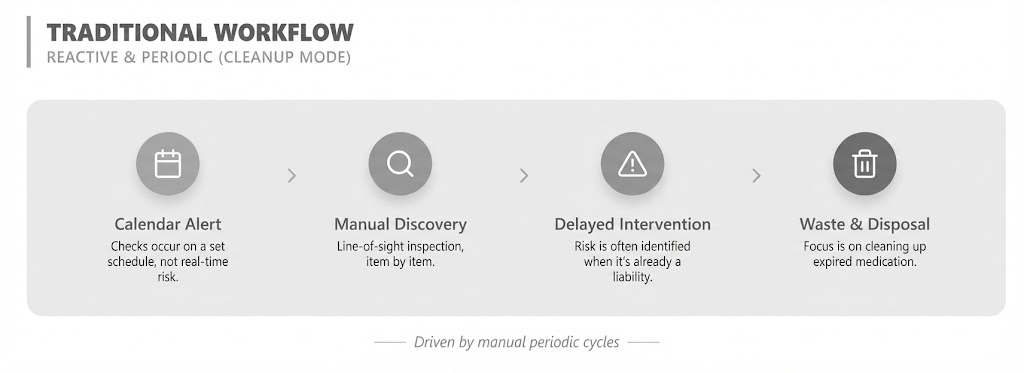
Traditional workflows depend on periodic, manual discovery. Expiration checks occur on a calendar rather than in response to real-time risk, which delays intervention. RFID replaces this model with routine, non-line-of-sight scanning that captures expiration and lot data across many items at once.
With RFID, visibility arrives earlier. Pharmacy teams can identify medications approaching expiration well before they become a liability, creating time to prioritize stock usage, reroute stock, or adjust purchasing decisions. This earlier signal changes the nature of expiration management from cleanup to control.
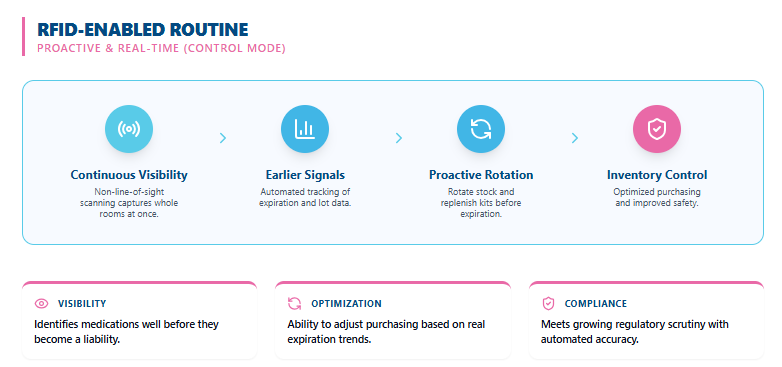
Hospitals are increasingly evaluating RFID to improve medication accuracy and safety, particularly as inventory complexity grows and regulatory scrutiny increases.
Where RFID Delivers the Greatest Impact in Hospital Workflows
High-value, temperature-sensitive medications with short shelf lives present high expiration risk. Maintaining precise control over these assets is critical, yet many facilities continue to struggle with costly stockouts and excessive waste due to expirations.
Health systems applying RFID to these medications report meaningful gains, such as:
- Sentara Norfolk General Hospital eliminated waste, totally more than $49,000 annually, by using RFID within a single fridge that contained expensive cardiac OR medications
This use case highlights how RFID’s ability to monitor inventory in any location delivers outsized operational value.
RFID Outperforms Barcode and Manual Expiration Checks
RFID scans multiple medications at once, eliminating the need for item-by-item handling. Visibility extends across full inventories rather than relying on sampled checks or spot audits. This breadth allows pharmacy teams to understand expiration exposure system-wide instead of reacting locally.
Because expiration data is captured continuously, RFID identifies risk earlier than manual review or barcode workflows that depend on scheduled effort. The same data foundation accelerates recall workflows, since lot and expiration information is already associated with each item and location.
Building Better Expiration Routines With RFID Data
RFID’s impact depends on how data is operationalized. High-frequency scans replace calendar-based inspections, ensuring expiration visibility remains current without adding manual burden. Defined thresholds can trigger proactive removal or replenishment, shifting effort earlier in the lifecycle.
Centralized dashboards support consistent action across locations, reducing variation between departments or sites. Automated alerts further reduce dependence on individual vigilance, allowing teams to focus on response rather than detection.
Applying RFID Expiration Control With KitCheck and KitCheck Anywhere
Earlier visibility enables prevention rather than cleanup. Standardized RFID routines scale across health systems, strengthening compliance while reducing waste.
Together KitCheck and KitCheck Anywhere provide RFID-based tracking across kits, trays, and inventory across your health system, enabling consistent expiration visibility at scale. Learn more about how these solutions can support your organization by reaching out today.