






RFID vs. Barcode: What’s the Difference?
Before we dive into the difference between barcodes vs. RFID labels, let’s define what both of these terms mean.
Definition of a Barcode
A barcode stores an ID in a printed pattern that a scanner reads optically.
In healthcare settings, this usually means line-of-sight scanning, so the label must be visible and the item is typically scanned one at a time. That makes barcoding a strong fit for straightforward workflows like:
- Dispensing verification
- Bedside medication administration (BCMA)
- Basic inventory check-in or check-out
In hospital pharmacies, the tradeoff is that barcode processes can slow down when volume is high.
When staff have to individually handle and scan each dose, it can introduce workarounds (for example, scanning a package instead of a single unit dose) and can increase the odds of missed scans or data gaps. Barcodes also tend to hold limited, fixed data, so any updates (location changes, status changes, or cycle count notes) usually live in the software system, not on the label itself.
Definition of RFIDs
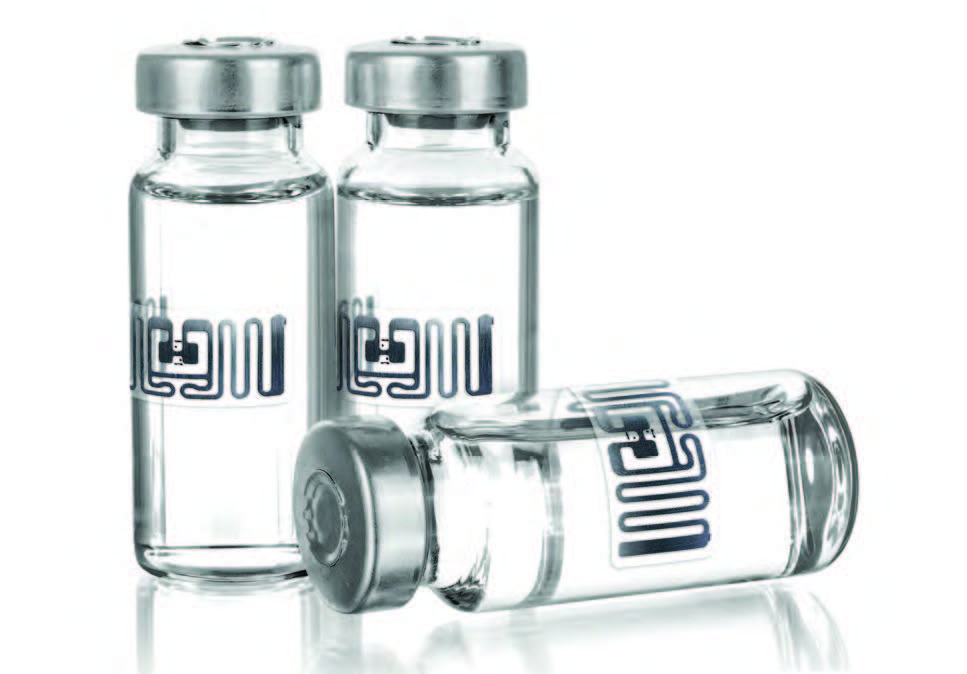
RFID (radio-frequency identification) uses radio waves to read data from an RFID tag using a reader, without requiring the tag to be visible.
In hospital pharmacies, RFID tags can be attached to medications and can store key fields like contents, location, dosage info, expiration date, and batch or lot number.
The operational impact in healthcare is speed and visibility. Because RFID readers can identify multiple tagged items in one scan, teams can verify kits, trays, and inventory faster, which supports tighter control of expiry management, lot tracking, and inventory accuracy when medications move quickly across departments. RFID can also support read/write behavior depending on the tag type and workflow, meaning data can be updated on the tag, which can be useful for reuse and some tracking scenarios.
How does RFID compare to barcoding?
Both RFID and barcoding have their own pros and cons and certain types of use.
Pros and Cons of Barcodes in Healthcare
Barcodes cost less than RFIDs (upfront) and they are more commonly used. But, are barcodes the best option for complex organizations like hospitals? Barcodes are specifically suited for more simple processes and are limited to being scanned one at a time. Barcodes also disrupt certain workflows commonly used in a hospital, causing the need for workarounds and increasing the chance of inaccuracies.
Pros and Cons of RFID in Healthcare
Both RFID and barcoding help identification, medication tracking, and capture data, but they behave differently in hospital pharmacy workflows.
Barcodes in healthcare
Pros
- Lower upfront cost than RFID
- Commonly used and widely supported
- Works well for straightforward, single-item verification workflows
Cons
- Requires line-of-sight and is typically scanned one at a time
- Can slow down high-volume hospital pharmacy workflows
- Often leads to workarounds, which can increase the chance of inaccuracies
RFID in healthcare
Pros
- Scans multiple medications at once, saving time and operating costs
- Improves visibility as drugs move quickly throughout hospitals
- Tags can store more information (for example expiration date, batch/lot number, location, dosage info)
- Faster data capture than barcodes
- Read/write capabilities allow updates; some tags can be rewritten and reused
Cons
- More expensive than barcodes
- Larger upfront investment, which can be a barrier for some organizations
With drugs moving at a high speed throughout hospitals, pharmacists need more visibility into their medications. RFID provides just that! Through the use of radio waves, a pharmacist or technician can scan multiple drugs at once, saving both time and operating costs. They also make the drugs more “intelligent.” RFID tags have the capacity to store and transmit more information at faster speeds than barcodes. RFID also has both read and write capabilities, which means that additional or updated information can be sent to the tags. This functionality also allows tags to be rewritten and reused for cost savings. As with every new technology, RFID is more expensive than barcodes and can have a large upfront investment, which may be a barrier to some.
Frequently Asked Questions
1) Question: What is the main difference between RFID and barcode labels?
Answer: Barcodes store information in a printed pattern that must be scanned with line-of-sight, usually one item at a time. RFID uses radio waves to read information from tags without direct visibility, and it can scan multiple items in a single pass.
2) Question: Why do barcodes create workflow issues in hospital pharmacies?
Answer: IIn complex, fast-moving environments, barcode workflows can require extra handling and one-at-a-time scanning. That can slow processes, lead to workarounds, and increase the chance of missed scans or inaccurate inventory data.
3) Question: What information can RFID tags store for medications in a hospital?
Answer: In hospital pharmacies, RFID tags can be programmed with medication details such as contents, location, dosage information, expiration date, and batch or lot number. This supports faster checks and better visibility as medications move through the hospital.