







Drug acquisition costs remain one of the most controllable yet consistently mismanaged areas of hospital pharmacy spend. Contract renegotiation alone rarely delivers lasting financial results, especially as wholesale acquisition costs shift faster than traditional oversight models can respond. Sustainable savings depend on real-time visibility, market benchmarking, and decisive action at the NDC level.
Common Cost Pressures Being Actively Managed
Drug acquisition costs are shaped less by utilization trends than by the mechanics of purchasing execution. Contract terms, timing of price changes, and NDC-level variability all influence what a pharmacy ultimately pays for a medication. Two facilities purchasing identical products under similar contracts can experience materially different acquisition outcomes based on wholesaler alignment, contract compliance, and point-of-purchase decisions.
This variability helps explain why an institution’s average drug acquisition cost frequently diverges from national average drug acquisition cost benchmarks. These gaps are not always the result of unfavorable contracts. More often, they reflect inconsistent execution, delayed response to pricing changes, or limited visibility into how prices compare across the market.
At the same time, the wholesale acquisition cost of drugs has become a less reliable indicator of true market pricing. WAC trends increasingly fail to reflect net acquisition cost after discounts, chargebacks, and contract adjustments, complicating forecasting and budget accuracy.
Why Market Price Changes Rarely Translate Into Savings
When WAC prices decline, the opportunity for savings exists, but the reduction does not automatically flow through to pharmacy spend.
- Without deliberate operational response, lower list prices may have little effect on what a health system actually pays.
- Purchasing systems continue to source familiar NDCs, and contracts may not immediately reflect updated pricing.
- Manual price file reviews and retrospective reporting further slow response time. By the time pricing discrepancies are identified, the opportunity window has often closed.
- Fragmented pricing data across wholesalers, facilities, and care settings compounds the issue by limiting accountability at the point where purchasing decisions are made.
The result is a persistent gap between market movement and financial impact. Awareness of price changes exists, but execution lags. CMS-published negotiated pricing files offer an additional reference point by providing inflation-adjusted, NDC-level market data.
When combined with internal benchmarks, these external comparisons help pharmacy leaders assess pricing performance, validate contract compliance, and prioritize issues that warrant investigation. CostCheck consolidates these benchmarks into a single view, making overpayment and contract risk visible while corrective action is still possible.
How To Reduce Drug Acquisition Costs by Acting at the NDC Level
Meaningful reductions in drug acquisition costs often begin with decisions made at the NDC level. Therapeutically equivalent drugs can carry materially different acquisition costs based on manufacturer, package size, or contract alignment, even when formulary status is the same. These differences create opportunities for immediate savings without introducing clinical disruption.
Drivers of NDC-level cost variation include:
- Manufacturer and package-size pricing differences for equivalent products
- Contract alignment and eligibility at the point of purchase
- Lag between market price changes and purchasing execution
While NDC optimization is one of the fastest ways to reduce acquisition costs, identifying opportunities quickly enough remains a challenge. Pricing shifts occur frequently, and static reports lack the timeliness required to support real-time decision-making.
CostCheck closes this gap by continuously monitoring NDC-level pricing and alerting pharmacy teams when lower-cost options become available, enabling action before excess spend accumulates.
Operationalize Contract Oversight Instead of Periodic Review
Contract oversight is often treated as a periodic exercise rather than a continuous operational function. As a result, pricing errors and contract discrepancies can persist for months without detection, quietly inflating drug acquisition costs.
Continuous monitoring changes that dynamic. Evaluating price fluctuations and contract performance in real time allows pharmacy teams to identify anomalous increases, missed discounts, and overcharged accounts as they occur. CostCheck’s Contract Manager supports this approach by flagging pricing deviations and contract errors across accounts and suppliers.
Defined workflows ensure these findings translate into action. Identification alone does not reduce spending. Issues must move from detection to resolution to recovery.
How to Control Drug Acquisition Costs Across All Care Settings
A significant portion of hospital drug spend now occurs outside traditional inpatient pharmacy operations. Outpatient clinics, infusion centers, and retail environments introduce additional pricing variability and exposure. Each setting may operate under different contracts, wholesalers, and purchasing practices.
Without system-wide visibility, health systems struggle to maintain consistent acquisition strategies across these environments. Price discrepancies persist unnoticed, and opportunities to standardize purchasing are missed.
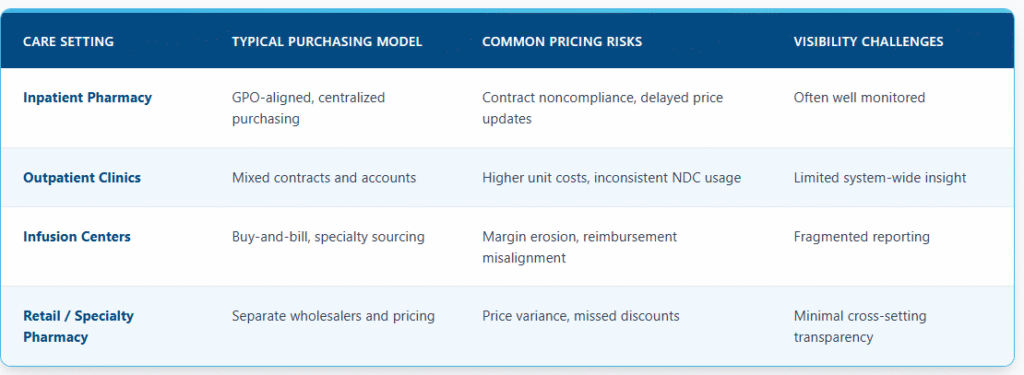
CostCheck delivers visibility across inpatient, outpatient, and retail settings, allowing pharmacy leaders to manage drug acquisition costs holistically rather than in silos.
Turn Pricing Intelligence Into Measurable Financial Impact
Timeliness determines recovery potential. The earlier pricing issues are detected, the more value can be recovered through refunds, corrections, and avoided overpayment. Retrospective audits may identify problems, but they rarely capture the full financial upside.
CostCheck customers have documented multi-million-dollar savings through recommended purchasing changes and successful overcharge recovery. Transparent pricing data strengthens accountability and governance by tying financial outcomes directly to purchasing decisions.
Build a Sustainable Model for Ongoing Cost Control
Sustainable reduction in drug acquisition costs requires moving beyond one-time audits and periodic reviews. Continuous pricing intelligence replaces lagging indicators with real-time insight that supports consistent execution.
By centralizing pricing data, benchmarking, and contract performance into a single source of truth, CostCheck enables pharmacy leaders to respond to market changes as they occur. Over time, this approach reduces variability, strengthens contract compliance, and lowers overall acquisition costs.
Pharmacy leaders looking to strengthen procurement performance and reduce operational risk can explore how CostCheck supports real-time pricing decisions, contract oversight, and savings identification through an on-demand demo.